
Texture Printing Will Change Art
How texture printing may create a new product category between the poster and the masterwork — and what that means for painting, reproduction, and the art market.
Painting has always been two things at once: a picture and an object. A Rembrandt portrait is a face, but it is also a surface where thick strokes of lead white rise from the canvas and catch the light before the darker ground beside them does. That duality is what makes painting irreplaceable in a way that a photograph of a painting never quite is. You can photograph the face. You cannot photograph the way the paint moves forward and recedes in a room.
For centuries, every technology of reproduction pursued only the picture half of this equation. Engraving captured line and contour. Mezzotint expanded the range of shadow and tonal richness. Lithography and chromolithography brought color to wider audiences. Photography and photomechanical processes pushed descriptive accuracy further still. Each advance transmitted another dimension of pictorial information while the built, physical surface of the painting remained out of reach. A poster of Courbet's The Wave can approximate the surge of gray-green and the churning sky, but the dense ridges of palette-knife paint that make that canvas project into the room, the way the surface catches light at an angle and goes almost sculptural, are gone. Flattened. The object becomes an image, and something essential is lost.
Texture printing may be the first reproduction technology to address that loss directly. Through high-resolution scanning and layered UV-curable inkjet deposition, it reconstructs relief on the surface of a print, so that ridges catch light, edges cast minute shadows, and the reproduction begins to behave less like a picture and more like an object in a room. The primary significance is that it may produce reproductions substantial enough to occupy a position the art market has long left empty: somewhere between the cheap poster and the singular masterwork, a middle category of worthwhile wall objects for people who care about what they live with but will likely never bid at an auction.
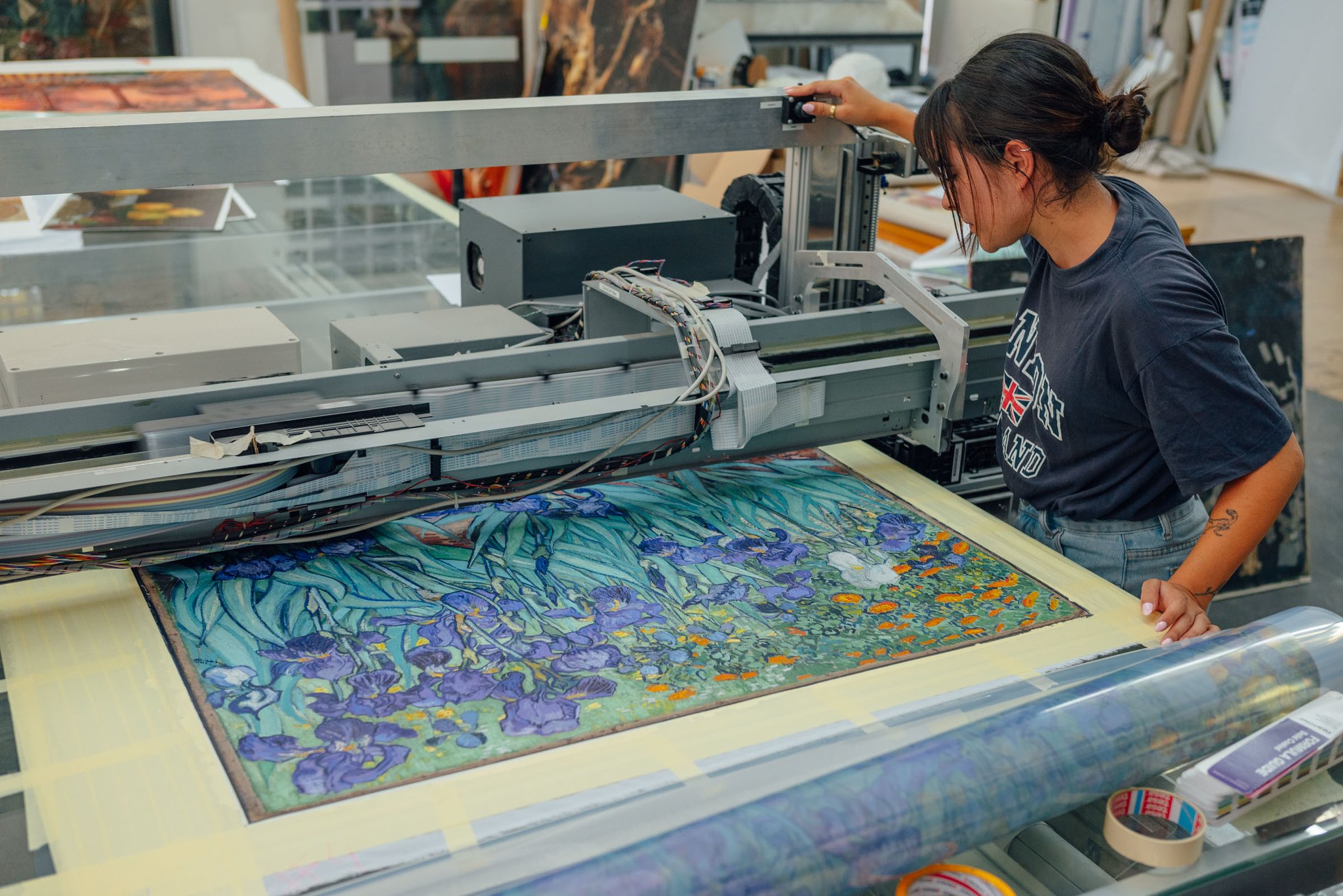
Amanda Blázquez printing the restored colour over the surface © Oak Taylor-Smith | Courtesy of Factum Foundation
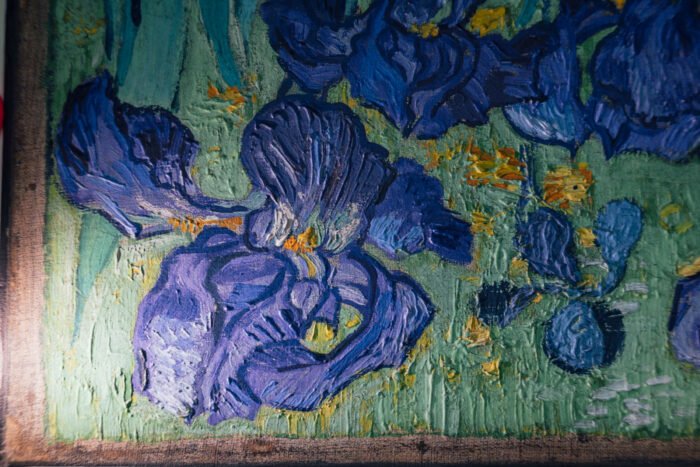
Detail of the printed colour © Oak Taylor-Smith | Courtesy of Factum Foundation
I argue that if texture printing matures into a reliable medium, and if the institutions around it develop adequate standards, it could alter the structure of the art market. This is a sizeable claim, and it rests on several premises worth examining one at a time.
I. Why Painting Still Resists Reproduction
What flat reproduction preserves most easily is the image of a painting. What gives painting much of its force is that it is not only an image.
Consider what happens when you stand in front of a heavily worked canvas. The depicted scene sits there, of course, but so does the surface itself: ridges of impasto catching raking light, passages of thin wash absorbing it, glossy varnished areas routing your eye in one direction while matte grounds pull it in another. The surface is thick with evidence of its own making. You can see where paint was dragged, scraped, built up in layers, wiped back. Museums examine works under raking light precisely because these surface qualities are integral to the painting's visual structure. A painting's appearance shifts with your angle, your distance, the time of day.
This is what gives painting its peculiar authority as a medium. A glossy passage and a matte one do not simply differ in finish; they direct the viewer's attention differently. A raised stroke advances toward you even when the depicted space behind it recedes. A scraped edge reveals the sequence of the painting's construction. These are perceptual facts, and they explain why even very good reproductions of paintings can feel strangely inert on a wall. The reproduction preserves the composition and colour, and loses the thing that makes the painting assert itself physically in a room.
Seen this way, the history of reproduction is a story of progressive conquest over the flat dimensions of painting while the three-dimensional ones remained stubborn. Engraving and etching mastered line. Mezzotint, first developed in the seventeenth century and favoured especially in England, captured tonal transitions that line engraving could not manage. Lithography, invented by Alois Senefelder in 1796, and its chromolithographic successor made color printing economically viable at scale. Photography then pushed accuracy to the point where the image could be transmitted almost perfectly. Yet through all of this, relief, gloss variation, and surface topography stayed out of reach, because they are generated by a physical object interacting with light, and that interaction cannot be captured from a single frontal photograph.
Reproduction grew steadily more faithful to the picture while leaving the object behind. The gap between original and reproduction remained large and tangible. You could feel it on the wall. But that is what’s to change.
II. When Reproduction Becomes an Object
The relevant threshold here is not whether a reproduction can become identical to the painting it copies. It cannot. The question is whether a reproduction can become convincing enough as a physical thing that the viewer's experience of it shifts. Instead of looking at a flat reminder of another object, you would be looking at an object that holds its own in a room. That is a lower bar than authenticity, but a much higher bar than mere fidelity, and it could mark a genuine category shift rather than an incremental improvement.
Texture printing, sometimes marketed as elevated or 2.5D printing, works through a multi-stage pipeline. First, the painting's surface is captured as three-dimensional geometry using photogrammetry, fringe projection scanning, or related methods. The Lucida 3D Scanner developed by Factum Foundation operates at a non-contact distance of roughly ten centimeters and has been used to document works from Rembrandt to the tomb of Tutankhamun. Fringe projection systems have achieved 25-micron resolution on scanning tiles of around 180 by 90 millimeters, with the scan of Rembrandt's The Jewish Bride yielding approximately one billion three-dimensional data points across its two square meters of surface. This captured geometry is converted into height maps, cleaned, rescaled to the printer's physical constraints, and merged with aligned color and gloss data. The build stage then uses UV-curable inkjet deposition: very thin layers of ink, each between just a few micrometers thick, are laid down and cured under ultraviolet light after every pass. A low-relief surface accumulates gradually from these controlled deposits rather than from a single embossed stamp. Current commercial flatbed UV systems can build relief up to several millimeters high at resolutions reaching 1,200 dots per inch.
What this means in practice is that raised passages on the print can catch light before adjacent areas, edges can cast minute shadows, and the surface reads as something constructed rather than merely pictured. Gloss enters as a secondary refinement: once physical relief exists, local variations of sheen make the surface behave more plausibly under changing light and prevent it from looking uniformly synthetic. In the most advanced facsimile work, gloss is treated as an additional appearance channel because color and relief alone still leave visible artificiality.
The process can still fail in many ways. Crude or over-simplified height data produce a schematic surface rather than a persuasive one. Visibly stepped layers make the result look stamped rather than built. Paintings whose power depends on translucency, staining, or chromatic depth more than on impasto offer narrower opportunities for textured reproduction. Even the technical literature describes current systems in measured terms: useful first-order reconstructions of appearance, not a transfer of authorship or every material nuance of the original. The strongest version of the claim is also the most defensible. Texture printing does not equate the source material, and it does not make all paintings equally reproducible. What it does is address, for the first time with practical plausibility, the specific weakness that kept reproduction from producing credible wall objects: the inability to rebuild painted surface.
Once that gap narrows at the level of objecthood, even imperfectly, the consequences extend beyond aesthetics. The old contrast between cheap reproductions and original paintings rested partly on a visible material difference that no technology could close. With that difference now partially addressable, the question becomes economic: what sort of market exists for reproduced wall objects that are materially significant?
III. The Market Gap
The market for paintings is not a continuous spectrum of gradually more expensive objects. It is structured as a split with a thinly developed middle. At one end sit mass reproductions sold through the language of accessible decor: framed prints, canvas prints, posters, customizable sizes, and platforms where browsing is organized by room or color scheme. At the other end sit original artworks circulating through galleries, fairs, and auctions, where value is anchored in authorship, rarity, provenance, and the work's status as something singular. The 2025 Art Basel and UBS Global Art Market Report tracks this upper world of dealers, auctions, and fairs as its primary frame of reference, which is another way of saying that what counts institutionally as "the art market" remains organized around masters and their channels of exchange.
What falls between these two poles is surprisingly thin. Limited-edition prints exist, and some are sold with care, but the dominant retail formats for pictorial wall objects remain flat or nearly flat. That absence has historical causes. Reproduction industries became commercially strong by expanding image access: more pictures, more sizes, lower prices, faster delivery. Their competitive advantage lay in circulating images rather than fabricating ambitious objects. The upper reaches of the art world, meanwhile, have strong reasons to preserve the distinction between the unique work and every reproducible surrogate. It is the predictable result of how each side of the market optimized for its own strengths. Reproduction was optimized to distribute pictures. Fine art institutions were optimized to defend singular works.
The relevant comparison here extends beyond the art world narrowly defined. In furniture, lighting, and textiles, consumers already navigate a dense hierarchy of categories organized by design authority, fabrication quality, material finish, and presence in a room. Design-centric retailers operate on the assumption that millions of households will spend heavily on objects whose appeal lies in material quality and spatial presence. In the United States, personal consumption expenditure on furniture, furnishings, and floor coverings reached approximately $251.8 billion in 2024. People spend on interiors quite seriously. Yet the things hung on their walls often occupy only the cheap-decor end of this hierarchy, as if pictorial art for non-collectors must be either disposable or out of reach. The mismatch is such that the rest of the domestic interior already supports a rich gradient of durable goods, while pictorial objects remain stuck in a binary.
The thinness of this middle category has made demand look weaker than it actually is. The global art market recorded an estimated 40.5 million transactions in 2024, and mass wall-art retail is plainly extensive. The issue is evidently not that people are unwilling to buy visual objects. But rather it is that buyers who want a serious wall object without entering the collector's economy have been offered mostly two unsatisfactory translations of that desire. If texture printing matters economically, it is because it may supply one of the conditions this middle has long lacked, that is, an object substantial enough to justify different standards of value.
IV. A New Category of Art Goods
Given that missing middle, the most useful way to understand texture printing is as the basis for a new product class rather than as a premium refinement of existing prints. A workable name for this class, borrowed from Canon and Factum Foundation's terminology, is elevated prints. The term matters because it captures two features at once. The object is elevated in the literal sense. Its built surface is part of what the viewer sees and what light encounters, and explains itself without drawing excess attention to its own novelty. And it is a print in the economic sense: repeatable, controllable, distributable in multiple instances without claiming to be a singular painting. This is clearer than "print" in the older flat sense, because the transferred image is no longer the whole object, and clearer than "facsimile," because the point is not only archival imitation but a livable, ownable wall presence.
The value of elevated prints would not depend on singularity. It would come from the same set of qualities that generate value in other well-made durable goods: precision of fabrication, persuasiveness of the surface, scale and proportion suited to the space, quality of substrate and frame, discipline of editioning, and intelligence of selection building towards a reputable brand. A poor elevated print would still look gimmicky or synthetic. A good one would make its case through restraint and finish. There ought to be enough relief to register as built, enough control to hold light convincingly, enough discipline to avoid becoming caricatural. Curation would matter as much as engineering. Not every painting merits reproduction in this form, not every interior calls for the same scale or degree of surface emphasis, and not every type of person needs to be appealed to.
But many consumers already understand this kind of value in other domains. High-end marketplaces sells iconic furniture as authentic, fully licensed products whose legitimacy comes from design pedigree, authorized production, and material execution rather than uniqueness. Hermès presents leather goods through the language of artisanal craft, exceptional materials, and long-practiced skill, and no one expects each bag to be singular in the way a painting is singular. In both cases, buyers understand that an object can be repeatable and still command serious prices, because the worth lies in design, fabrication quality, finish, and social legibility. Elevated prints would ask to be understood in roughly that way: as cultural goods whose value comes from how convincingly they turn reproduced images back into substantial things.
Masters would remain apart. Their value is tied to singularity reinforced by the market, to the irreducible contingency of a work made once by a particular hand in a particular moment, and to the institutions of provenance, scholarship, and museum stewardship that protect that singularity. Elevated prints do not need to challenge this. They serve a different purpose: expanding what "having art" can mean for the person who will likely not own a master but who does care, genuinely, about what occupies the walls of the place where they live.
V. Consequences and Limits
No product class establishes itself on technology alone. The credibility of elevated prints will depend on who produces them, how standards are set, and how sharply the category's limits are understood.
Some museums already sell custom reproductions of works in their collections. Estates already control and license the reproduction of artists' images. Factum Foundation has spent more than two decades producing high-fidelity facsimiles for institutions ranging from the Louvre (their full-scale recreation of Veronese's Wedding at Cana, installed at San Giorgio Maggiore in Venice in 2007) to the Egyptian Supreme Council of Antiquities (a facsimile of Tutankhamun's burial chamber, completed in 2014, based on the highest-resolution large-scale digital documentation undertaken at the time: over 16,000 photographs at 600 to 800 DPI and comprehensive 3D scanning with the Lucida system). These precedents matter because they show that institutions already have experience making judgments about reproduced objects, setting quality thresholds, and presenting facsimiles in serious contexts. In 2024, the British Museum installed Factum's Selene photometric stereo system to digitize over 130,000 cuneiform tablets; the Georgia Museum of Art and Princeton University Library have deployed similar systems for their own collections. If elevated prints are to become a stable category, the likely arbiters will include not only museums and estates but also publishers, specialized reproduction firms, design retailers, and hospitality and interior-design channels that already decide what kinds of art-adjacent objects enter everyday spaces.
Should those actors begin treating elevated prints as a serious category, domestic taste could shift significantly over the next decade. The most immediate change would be a weakening of the binary that has long forced non-collectors to choose between cheapened wall decor and nothing at all. Taste would then develop less exclusively through occasional encounters with museums or galleries and more through repeated daily experience. That is how most consumer categories seem to mature. A larger public begins making finer distinctions because the products in circulation are worth distinguishing between.
It is worth noting the limits. No elevated print can carry the singular event of making, the historical position of the master, or the chain of provenance that ties a work to institutions and scholarship across time. These are not technical deficits awaiting better engineering as they belong to what a reproduction is. Other limits are more contingent. Surface relief and gloss variation may now be reproducible with growing persuasiveness, but subtler properties still resist full transfer: the depth of certain pigments, the translucency of glazes, edge behavior at fine scales, the atmospheric effects of particular media, and the countless local accidents that arise from fluids moving under a specific hand at a specific moment. The history of reproduction, however, has repeatedly advanced by capturing dimensions that earlier systems left behind. The convergence of high-resolution surface scanning, computational processing, and layered UV deposition suggests that this process is accelerating. Even rapid improvement, though, would leave the strongest boundary intact. A reproduction may narrow the gap in appearance and objecthood. It does not become the thing itself.
The significance of texture printing lies in the possibility of creating a new social and economic place for art objects. Should that place stabilize, the art market will have become less binary. Between the singular work preserved by institutions and the flat image sold for convenience, a third form may hopefully emerge. A scalable wall object with enough material authority to be lived with, judged, and wanted on its own terms. And without dissolving the old order, it would expand the conditions under which extraordinary art can matter in ordinary life.